Introduction and purpose of this document
This document sets out the principles and features of our funding system for the 2026 to 2027 funding year (1 August to 31 July) for Devon and Torbay Combined County Authority (DTCCA) area funded adult skills fund (ASF) delivery. We may make changes to these principles and features during the funding year.
The DTCCA will only fund Devon and Torbay provision for learners whose learning starts in the 2026 to 2027 academic year. For Devon and Torbay learners who started their learning before 1 August 2026, providers must continue to fund and record those learners in accordance with the national ASF funding rules and guidance applicable to those starts.
This document describes how we calculate ‘formula-funded’ earnings for DTCCA funded ASF and learning support. We define ‘formula-funded’ activity as that recorded under funding model:
- 38 (‘adult skills fund’) for aims started on or after 1 August 2026
This document does not include or describe:
- the ‘non-formula-funded’ activity within DTCCA funded ASF which is reconciled through the funding claims process (this includes non-regulated learning recorded under tailored learning (funding model 11)) – for more information on funding claims and tailored learning, refer to the DTCCA ASF Funding and Performance Management Rules for 2026 to 2027
To understand how our funding system works, read this document together with:
- your Grant Agreement and/or Contract for Services
- the DTCCA Adult Skills Fund: Funding and Performance Management Rules 2026 to 2027
- the DTCCA Adult Skills Fund: Performance Management Framework 2026 to 2027
- the DfE Individualised Learner Record (ILR) for 2026-2027 and the DfE Provider Support Manual for 2026-2027.
Understanding the terminology
The term ‘we’ or ‘us’ refers to The Devon and Torbay Combined County Authority (DTCCA).
When we refer to ‘you’ or ‘Providers’, this includes colleges, higher education institutions, training organisations, local authorities and employers who receive funding from us to deliver adult skills education and training to DTCCA residents. We will use the generic term ‘you’ or ‘Provider’ unless the requirements only apply to a specific provider type.
The term ILR refers to the Individualised Learner Record produced to the ILR Specification 2026/27. This is the mandatory data return submitted by all funded Providers to the DfE via Submit Learner Data on a monthly basis.
Contacting us
You can contact us via email at: SkillsFunding@devon.gov.uk.
Devolution of the Adult Skills Fund
The government agreed a series of devolution deals between central government and local areas in England, and refer to these as Strategic Authorities (SAs) as described in the English Devolution White paper. SAs have the responsibility to ensure eligible learners who reside in their area have appropriate education and training.
Providers with funding for devolved delivery from a SA will use the ILR again in the 2026 to 2027 funding year. The source of funding (SOF) code 127 identifies the DTCCA whose contract is funding learners that reside in the DTCCA administrative area.
The DfE/DWP will provide funding reports for devolved delivery using their funding calculation. The detailed occupancy report will include the appropriate funding line type for the DTCCA using the SOF field from the ILR collection. This report may form the basis on which the DTCCA funds you, which could differ in amount or delivery methodology than that the DfE/DWP use. We (the DTCCA) will use our own systems and processes to pay you.
Refer to the ILR Specification and the Provider Support Manual for further details on recording devolved delivery.
The data we use to calculate funding
You give us information about learners and their learning using the DfE ILR and the Earnings Adjustment Statement (EAS). Our funding system uses this information to work out the funding you have earned for delivering this learning.
The DTCCA receives ILR derived data from the DfE containing details of your delivery to DTCCA learners and this is used to inform our performance, payment, and reconciliation processes.
You will be informed of any issues or concerns highlighted during the DTCCA processes.
The funding system features
The funding system has the following 4 features, which are set out in more detail throughout this document:
- the funding formula, including uplifts to the rates to account for the extra costs that you may experience when delivering learning to some types of learners and in some locations, or where there are skills shortages
- the funding rates for learning aims and work placements
- the earnings method, linked to delivery and achievement or completion
- support funding where extra help is needed for learners to achieve.
The funding formula
Principle
The funding formula for approved learning aims is below, and is unchanged from the DfE’s methodology:
Funding = rate x disadvantage uplift
The basis for funding is the rate for the learning aim.
The funding formula is adjusted to allow for geographical differences in the relative cost of delivery and to enable additional support for learners living in more disadvantaged areas. For further information see the Disadvantage Uplift .
In some cases, learners and employers are expected to share responsibility for investing in eligible provision. The DTCCA expect them to part-fund the cost of learning, known as co-funding. For more information on co-funding, refer to the ‘DTCCA Contribution Tables’ in the DTCCA ASF Funding and Performance Management Rules for 2026 to 2027.
Disadvantage uplift
The disadvantage uplift provides extra funding to support the most disadvantaged learners, recognising that they are sometimes more costly to recruit and retain. We apply this consistently across DTCCA ‘formula-funded’ ASF provision.
To support access and participation among learners facing the greatest disadvantage, DTCCA applies an enhanced disadvantage uplift to the national Adult Skills Fund (ASF) funding rates. The uplift continues to be based on a learner’s postcode prior to enrolment, using the Index of Multiple Deprivation (IMD) 2019 and the methodology set out by the Department for Education.
Under the national ASF funding methodology, learners living in the 27% most deprived Lower Layer Super Output Areas (LSOAs) attract a disadvantage uplift ranging from 8.4% to 33.6% above the base funding rate. To further support delivery in disadvantaged communities across Devon and Torbay, DTCCA applies a 10% increase to the disadvantage uplift calculated under the DfE methodology.
As a result, providers delivering within the DTCCA area will receive:
- A minimum disadvantage uplift factor of 1.192 for learners residing in the least deprived LSOAs that qualify for disadvantage funding.
- A maximum disadvantage uplift factor of 1.379 for learners residing in the most deprived qualifying LSOAs.
For qualifying LSOAs between these points, the uplift will be calculated on a sliding scale using the same linear methodology applied by the DfE, with the additional 10 percentage points incorporated into the resulting uplift.
If required, the DTCCA uplift factor is between 1.192 and 1.379; otherwise, we default the factor to 1.
The uplift applies to all learners whose postcode prior to enrolment falls within an eligible LSOA in the DTCCA area and is intended to recognise the additional costs of engaging and supporting learners from disadvantaged communities, helping providers deliver provision where it is most needed.
The disadvantage uplift factor at the start of the learning aim will apply throughout the duration of the learning aim.
For FCFJ we calculate the funding using the DWP’s disadvantage factors.
The national disadvantage uplift factors are available at Uplift Factors and Postcode Files.
Area cost uplift
No area cost uplift is applicable to any region with DTCCA.
Financial Contributions
If a learner meets the criteria for full funding you can claim the full rate for the qualification – refer to the DTCCA ASF Funding and Performance Management Rules for 2026 to 2027 for more information.
For co-funded learners, we expect the learner or employer to contribute so we reduce the funding by 50% of the unweighted rate of the learning aim as shown in Find a Learning Aim (FALA).
We reduce the funding using the unweighted rate because a learner should not contribute more for the same size of the learning aim just because that learning aim is more costly to deliver. This means that the DTCCA will contribute more towards learning aims with higher operational and delivery costs, such as engineering.
Recognition of Prior Learning
If you record data in the ‘funding adjustment for prior learning’ field on the ILR, we will change the funding formula to reflect this. However, it does not change the fixed monthly learning support funding.
If the learning aim does not use the restart indicator, we will reduce the achievement or completion funding as well as the monthly instalments. This is because we will assume the learner has earned some achievement or completion within the prior learning.
If the learning aim uses the restart indicator, we reduce the monthly instalments, but the achievement or completion funding stays at 20% of the full funding rate.
Other Funding Adjustments
Where you have agreement with us to adjust DTCCA funding upwards for other reasons apart from prior learning, you must record it in the ‘other funding adjustment’ field in the ILR. You must not use this ILR field for DTCCA upward revisions if you do not have an agreement in place with us. We will monitor its use. However, you can use this to reduce funding without our agreement.
This ‘other funding adjustment’ factor increases or decreases the funding for that learning, including the achievement or completion funding. However, it does not change learning support funding.
If there is also a factor for prior learning recorded, we multiply the ‘funding adjustment for prior learning’ factor by the ‘other funding adjustment’ factor and apply it to the appropriate funding.
Our funding rates
Principles
The list of regulated qualifications approved for public funding are on FALA, and is regularly updated by the DfE. For information about what is eligible for public funding, refer to the DfE publication Qualifications and Public Funding.
As rates can change between and during academic years (because of policy change or changes to the learning aim), the DTCCA funds each learning aim at the rate that applies when the learner starts that learning aim. This principle is the same for a new start in the current funding year and a continuing learner from previous years. This rate will apply for the full duration of the learning aim and does not change between funding years.
The amount you earn recognises the relative value and costs of delivering provision in different sectors and subjects. We set the rates using the following criteria:
- funded Guided Learning Hours (GLH)
- hourly rates that recognise the relative costs of delivering training in different sectors and subjects and provides a boost for training in those sectors identified as having greatest skills needs.
Sector uplifts are based on the Sector Subject Area (SSA) that awarding organisations decide. The Register of Regulated Qualifications and the Access to Higher Education websites record the SSAs. Some components of qualifications can have multiple SSAs, where this happens, we set the SSA.
The DfE/DWP may have some exceptions that do not use the criteria above. In these instances, the department sets rates for some policy areas and specific learning aims such as:
- work experience
- HGV medical
- HGV certificates of competence
- CSCS cards.
We add an uplift to the rate for all learners on FCFJ, more details can be found in the Free Courses for Jobs Offer section.
We refer to rates as ‘unweighted’ when calculated using the base rate of £6.00 per hour. Once we have calculated the rate using the appropriate skills funding band, we refer to it as the ‘weighted rate’. After we apply the uplifts, we refer to the ‘aim value’, as noted in the ‘main occupancy report’. For more information on funding reports see the Funding Reports section.
All rates shown on FALA are fully funded rates for learners aged 19 and above. We adjust these rates through the funding formula according to our policy (for example, if the government contributes only part of the full rate).
All learners funded through the 16 to 19 funding model that turned 19 in their second or subsequent funding year of a single programme of study are funded through the 16 to 19 funding model.
Funding rates do not change depending on how you deliver the learning (for example, by delivering it on-line compared to in the classroom). Where rates are based on GLH, the rate is always the funded GLH in FALA regardless of how many hours you deliver the learning in.
Funding rates
We will fund each GLH that is assigned to the qualification at an hourly rate, depending on the skills funding band assigned to the SSA of the qualification (see table 1). Each qualification is funded according to the specific GLH and SSA assigned to the qualification. Where a learning aim had a rate set in 2025 to 2026 (or earlier) and is continuing into 2026 to 2027, this rate remains unchanged for 2026 to 2027.
Funding rates for individual qualifications are determined by multiplying the relevant hourly rate for the SSA of the qualification by the number of GLH as assigned by the awarding organisation and recorded on Ofqual’s register of regulated qualifications.
We will use the GLH assigned by the awarding organisation and as recorded in Ofqual’s register. Where an awarding organisation amends the GLH for a qualification on Ofqual’s register, we may not automatically reflect this change in the associated funding rate. Therefore, there may be a difference between the GLH recorded on Ofqual’s register and the GLH we are using for the funding rate.
FALA shows the funded GLH in addition to the Ofqual GLH, so it is clear where there is a difference.
The Quality Assurance Agency for Higher Education (QAA) regulates Access to Higher Education Diplomas. The GLH for these qualifications is set at 600 hours.
Skills funding bands
Each SSA at tier 2 level is assigned to one of the 5 funding bands, see Table 1. The funding bands for each SSA tier 2 are set out in Annex 1.
We set all unweighted rates using the base rate of £6.00 per hour.
| Adult Skills Funding band | Base | Low | Medium | High | Specialist |
| Hourly adult skills funding rate | £6.00 | £7.20 | £8.40 | £9.60 | £12.00 |
An example of how the rates are set is as follows, taking Learning aim reference 60008817 Diploma in Engineering with funded GLH of 360:
- The unweighted rate is calculated by multiplying the funded GLH of 360 by the base rate of £6.00 – this gives an unweighted funding rate of £2,160.
- The weighted rate is calculated by multiplying the funded GLH of 360 by £9.60 (which is the hourly adult skills funding rate for high funding band that engineering SSA is in) – this gives a weighted funding rate of £3,456.
The following policy exceptions remain for these qualifications:
- English GCSEs are funded within the low funding band rather than the base funding rate band. This means they get a funding rate of £864 in line with the GLH of 120 and in line with the funding rate for maths GCSE
- functional skills in English entry level, level 1 and level 2, receive the current policy rate of £724
- functional skills in maths entry level, are funded at the policy rate of £941, and level 1 and level 2 at £724
- we fund digital functional skills qualifications under a different SSA’s funding band. We treat these as if they are in the digital technology (users) SSA from 2024 to 2025. This means the funding rate for digital functional skills qualifications is £462 (the new hourly skills funding rate for digital technology (users) SSA is £8.40 and GLH for these qualifications is 55 hours).
If you offer English for speakers of other languages (ESOL) qualifications, you may need to deliver additional learning to individual learners that incurs additional costs above the qualification rate. Where additional hours are required, you can record these on the ILR as detailed in the ILR Specification and the Provider Support Manual.
The steps for claiming top-up for an ESOL qualification that is planned to be delivered in 100 hours are:
- Identify the funded GLH of the ESOL qualification through FALA
- Work out the additional delivery hours you need to complete the learning – this is the 100 planned hours minus the funded GLH value of the ESOL qualification
- Record these hours using the ‘Hours Record: Entity’ in the ILR specification
- Use the attribute type ‘HRS’ and attribute code 6 – Additional Delivery Hours.
For example, you plan to deliver learning aim reference 60140070 Level 2 Award in ESOL Skills for Life (reading) in 100 hours which has:
- funded GLH of 60
- a skills funding rate of £360.
The additional delivery hours required is 40 (the 100 planned hours minus the funded GLH value of the ESOL qualification).
In the ILR, record the amount of 40 as the HRSAmount against attribute type ‘HRS’ and attribute code 6.
The funding calculation automatically calculates the additional funding as 40 x £6.00 = £240. The overall rate is calculated as the original rate (£360) + the top up amount (£240) = £600.
Land-based qualifications
In adult provision, 3 SSAs include land-based qualifications:
- agriculture (SSA T2 3.1)
- horticulture and forestry (SSA T2 3.2)
- animal care and veterinary science (SSA T2 3.3).
Funding for relevant land-based technical qualifications have the specialist funding band applied only where all the following criteria are met. If all 3 criteria are not met the provision will not be deemed specialist and will have the high funding band applied.
- Providers have a ‘specialist status’ as set out in Annex C of 16 to 19 Funding: Rates and Formula
- the qualifications within the 3 land-based SSAs do not meet any of the exceptions in the next paragraph
- a specialist Provider delivers a qualification at their land-based location that met specific and additional criteria within the 3 SSAs.
Specialist funding rate will apply to all technical level 2 and 3 qualifications, except for the following:
- qualifications where employment is a pre-requisite; this is because the training aspects requiring specialist equipment can take place on the employer’s premises. Note that qualifications linked to occupational regulation or a certificate of competence are an exception to this and are funded at the specialist funding rate
- qualifications within animal care and veterinary science SSA which are solely focussed on domestic animal care
- floristry qualifications within horticulture and forestry SSA as they do not require specialist provision
- qualifications related to forest schools
- qualifications related to garden design and planning.
Work placement for 19 to 24 year olds
We identify work placement learning aims through FALA using the Learning Aim Reference Service (LARS) category code ‘Adult Skills Fund – Work Placement (code 74)’.
The work placement hours referred to in the learning aim title represent the length of the placement. You should choose the learning aim reference with the appropriate hours for the work placement. Each rate is intended to reflect the administration and support costs associated with those hours.
The minimum total length of work placement we fund for a single learner is 70 hours.
The maximum total length of work placements we fund for a single learner is 240 hours.
The learning aims for work placement are shown in Table 2.
| Learning aim reference | Learning aim title | Funding rate |
| Z0030000 | Adult Skills Fund – Work Placement 70 to 80 hours | £450 |
| Z0030001 | Adult Skills Fund – Work Placement 81 to 160 hours | £724 |
| Z0030002 | Adult Skills Fund – Work Placement 161 to 240 hours | £1,265 |
For work placement aims, we do not hold back 20% of the rate for achievement or completion. Instead, we apportion all the funding for the aim as monthly instalments.
There are some additional funding eligibility criteria for work placement learning aims which are described in the DTCCA ASF Funding and Performance Management Rules for 2026 to 2027.
Free Courses for Jobs Offer
Additional funding is available through FCFJ for adults who meet the eligibility criteria and are studying a qualification from the list of approved FCFJ qualifications. Eligibility is described in detail in the DTCCA ASF Funding and Performance Management Rules for 2026 to 2027. We fund this learning as we fund other ASF delivery, with the following exceptions:
learners eligible for this offer are fully funded for their FCFJ learning aim
we increase the weighted rate by £600 for eligible aims in LARS category code 45 (‘Free Courses for Jobs rate 1’) or by £150 for eligible aims in LARS category code 46 (‘Free Courses for Jobs rate 2’)
we increase the £150 or £600 by the disadvantage uplift if applicable to that learning aim.
You should use the learning delivery and monitoring (LDM) code 378 (Free courses for jobs offer) for all FCFJ aims for both 19 to 23 and 24+ learners. This will ensure you earn funding for the £150 or £600 uplifts.
All FCFJ learning aims with LDM code 378, irrespective of age, are funded through your FCFJ funding line.
You must not use LDM code 382 for any starts on or after 1 August 2024.
DTCCA has some limited flexibility to use their ASF FCFJ allocation to fund additional qualifications which are not part of the national offer. The DTCCA will notify you about any qualifications where this flexibility applies. For these qualifications however, the funding calculation will not increase the weighted rate by £150 or £600.
King’s Trust team programme
The programme rate is the same as last year at £3,204. This programme rate is the same for both employed and unemployed learners. We do not apply uplifts for disadvantage and area cost to the programme rate.
You will earn the funding rate for the award or certificate in ‘Employment, Teamwork and Community Skills’. The qualifications you can use are in Table 3. You must also record the learners on the ILR using the LDM code 331.
| Qualification title | Learning aim reference |
| Certificate in Employment, Teamwork and Community Skills | 60023995 |
| Certificate in Employment, Teamwork and Community Skills (Entry 3) | 60027629 |
| Award in Employment, Teamwork and Community Skills | 60032121 |
| Award in Employment, Teamwork and Community Skills | 60032868 |
| Award in Employment, Teamwork and Community Skills (Entry 3) | 60033344 |
| Certificate in Employment, Teamwork and Community Skills | 60027307 |
If the funding rate is lower than the programme rate, you can claim additional funding from the qualification rate up to the value of the programme rate. To claim this additional funding, you must use the EAS adjustment type called ‘Kings Trust’. We will monitor the amounts being claimed.
Table 4 shows the qualification funding rates, the maximum programme rate and the maximum additional funding you can claim where appropriate. If the funding rate for the aim is uplifted for disadvantage you must adjust the additional claim accordingly using the maximum programme values in the table below. For example, a fully funded award when uplifted for area cost and disadvantage has a value of £665. The maximum additional funding is therefore £3,204 – £665 = £2,539.
| Funding rate | Award: fully-funded | Award: co-funded | Certificate: fully-funded | Certificate: co-funded |
| Qualification | £444 | £222 | £1,512 | £756 |
| Maximum programme cost for all learners | £3,204 | £1,602 | £3,204 | £1,602 |
| Maximum additional funding for all learners | £2,760 | £1,380 | £1,692 | £846 |
HGV driver training
The level 2 learning aims that prepare learners for the HGV licence are Ofqual regulated qualifications. These are funded in the same way as other regulated learning aims and can be found on FALA with LARS category code 50.
The HGV medical and certificates of professional competence (licence) have their own rates that allow eligible learners to be reimbursed for the cost. The HGV medical has LARS category code 51. The certificates of professional competence (licence) have LARS category code 52.
The HGV medical and certificates of professional competence do not attract disadvantage or area cost uplifts, and we do not hold back funding for achievement or completion.
Construction skills certification (CSCS) cards
The CSCS cards have their own rates that allow eligible learners to be reimbursed for the cost when delivered alongside specific qualifications. Refer to the DTCCA ASF Funding and Performance Management Rules for 2026 to 2027 for more details.
CSCS cards have LARS category code 76. Refer to LARS category codes for more details.
CSCS cards do not attract disadvantage and area cost uplifts. We do not hold back funding for achievement or completion.
Our earnings method
Principles
The following principles apply to our approach to your earnings:
- funding is distributed over the duration of the course starting from the date the learner started
- you earn funding for what you deliver, when you deliver it
- funding is directly linked to achievement or completion depending on your type of contract and when the learning aim started
- for aims funded through a Grant Funding Agreement , funding is directly linked to the learner completing the learning aim (or gaining employment).
- for aims funded through a procured Contract For Services, funding is directly linked to the learner completing their learning aim and achieving the learning aim (or gaining employment for job outcomes).
| Planned length of the learning aim | Qualifying period |
| 168 days or more | 42 days |
| 14 to 167 days | 14 days |
| Fewer than 14 days | 1 day |
We treat learners as having qualified for funding until a learning actual end date is recorded, at which point we calculate the actual length of the learning aim.
If a learner achieves or completes their learning aim in a shorter period than the qualifying period, then we treat them as having qualified.
If a learner generates on-programme earnings for passing a census date, then in a subsequent ILR return you record a learning actual end date (without an achievement or completion outcome) that does not meet the qualifying period, we will claw back the funding for that learning aim.
Distribution of funding over time
If you are grant-funded, then we will pay you an amount each month based upon the monthly profile in your contract and your allocation value. We then reconcile your funding after the final R14 ILR submission window using your earnings (‘earnings’ are what you have earned through the ILR and EAS submissions you send us). Therefore, your month by month earnings that we calculate will not affect your monthly payments. Rather, it is the overall earnings over the academic year that feed into the reconciliation process. We reserve the right to reconcile or make changes mid-year should earnings be significantly out of alignment with the expectations outlined in the DTCCA ASF Performance Management Framework 2026 to 2027.
Providers funded through a Contract for Services will be paid on actual delivery each month, based upon your earnings through your ILR and EAS data. The amount we pay each month may not match your earnings because of capping, or because you have an outstanding debt with us.
We calculate your earnings each month using the same process and system, regardless of the contract you have with us. We show you these figures through your funding reports (see the Funding Reports section for more information).
We base your earnings on monthly instalments plus an achievement or completion element. The achievement or completion element does not apply to:
- work placements
- HGV medicals
- HGV certificates of competence
- CSCS cards.
We hold back 20% of the weighted rate for each learning aim, which we will only generate when the learner achieves or completes their learning aim. You earn all achievement or completion elements on the learning actual end date recorded on the ILR.
We calculate the monthly instalments once we have removed the achievement or completion element (20%). We spread out these instalments over the number of planned months for the learning aim, with a double payment in the first month. The instalment calculation uses the formula ‘n+1’, where ‘n’ is the number of planned months. The formula recognises the upfront costs associated with enrolling a learner on a learning aim.
You earn the instalments if the learner is in learning on each census date (the last calendar day of every month). The planned number of months is calculated from the ‘learning start date’ and the ‘learning planned end date’ in the ILR specification.
If the learner leaves early, the monthly instalments stop. However, for eligible learners we will pay you a job outcome payment which will be half of the achievement or completion element. If the learner then goes on to achieve or complete the learning aim, you will earn the outstanding monthly instalments and the rest of the achievement or completion element. For more information on job outcomes, refer to the DTCCA ASF Funding and Performance Management Rules for 2026 to 2027.
If a learner leaves before the census date of the first month of learning and the aim has already passed the qualifying period for funding, you will earn the payment relating to this month.
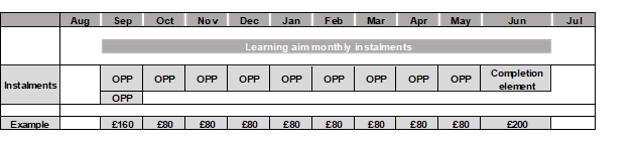
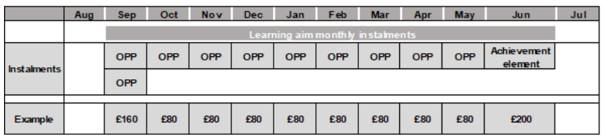
Figures 1 and 2 show an example of the earnings method for a learner starting a course in September:
- with a planned end date in June
- completing or achieving in June.
- It shows how you earn funding for a course with a total cost of £1,000 over the period of learning:
- 9 monthly on-programme payments (OPP) of £80, plus an additional monthly OPP of £80 in the first month
- an achievement or completion payment of £200.
Recording late data in the ILR
If a learner is continuing learning at the final R14 collection at the end of the year, but you record in the subsequent ILR year that they left before 1 August, you may have earned funding that you need to pay back.
- For example, at R14 in the 2026 to 2027 ILR you record a learner as starting on 1 June 2027, having a planned end date after 31 July 2027 and their completion status is ‘continuing’. In the 2027 to 2028 ILR you record them as having left on 18 July 2027. In this scenario, they will have earned monthly on-programme payments in June and July 2027 from the 2026 to 2027 ILR, therefore the July payment will need to be paid back. We will contact you separately after the R14 return to recover the funding that relates to FRM27. You do not need to take any action in-year for this report. Do not submit repayments for FM27 through the EAS.
For more information on recording late data in the ILR, refer to ’The impact of incomplete information’ in the ILR Provider Support Manual.
Support funding
Learning support
You can access this funding through the DTCCA funded adult skills fund and you record this against a learner’s learning aim in the ILR Specification.
If you record learning support against a learning aim in the ILR, you will earn a fixed monthly rate of £150. We expect the total you earn from the monthly rate to be enough to cover your costs. If the cost of providing support to a learner exceeds the total earned from the fixed monthly rate, you can claim this excess through the EAS.
For learning aims with a planned length of less than one calendar month, our funding calculation will calculate the £150 appropriately in most cases, and you should not need to use the EAS to claim the learning support. However, if you see that this funding has not been reflected in your funding reports, and we expect this to be in exceptional cases only, then claim the learning support through the EAS.
If learning support is more than £19,000, you can claim exceptional learning support above £19,000 using the cost form. You do not claim the amount above £19,000 through the EAS. The EAS can only be used for claiming the amount up to £19,000 (subtracting what you may have earned through the ILR). For more information, refer to the DTCCA ASF Funding and Performance Management Rules for 2026 to 2027.
Learner support
Learner support is available to provide financial support for learners with a specific financial hardship preventing them from taking part or continuing in learning.
Learner support is not formula-funded so you cannot claim it through the ILR, you must claim it through the EAS.
Where you make an EAS claim, you must submit an EAS file to the DTCCA monthly, alongside your ILR return. You must not wait until the final funding claim point to supply this data.
For further information, see the EAS and Funding Claims Guidance.
Procured DTCCA funded ASF provision
If you have a procured Contract for Services with us, you must assign Devolved Area Monitoring (DAM) Code 002 to each ASF of FCFJ learning aim. This LDM code distinguishes between our procured and grant-funded contracts so we can identify which contract will pay for provision. Failure to record this code correctly may result in ILR errors or no payments.
Table 6 shows the LDMs you should use to indicate which contract you wish to use to pay for different types of adult delivery, and when they are valid.
| Type of learning | All learning aims |
| ASF non-procured (grant funded providers) | No LDM |
| ASF contract for services (procured) | DAM 002 |
| Non-procured provision within FCFJ (grant funded providers) | LDM 378 |
| Contract for services provision within FCFJ | LDM 378 and DAM 002 |
Funding reports
We will provide funding reports to show you what funding we have calculated for you. These will range from headline funding reports to detailed reports at learner and learning aim level, like the funding summary reports and occupancy reports the DfE provided in previous years.
You will receive a set of reports when you submit your ILR data that will indicate how much you have earned. There will be 2 main reports for formula-funded adult skills fund provision that we fund:
- Occupancy report – this report gives the most detailed information at learner and learning aim level
- Funding summary report – this report gives you the aggregated information by month and for each funding line type (subcategories within the budget).
All learning aims that started before 1 August 2024 and continue into the year 2026 to 2027 should remain being recorded in the ILR using funding model 35 (‘adult skills’).
Annex 1: List of SSAs with adult skills funding bands and hourly rates
| SSA tier 2 | SSA tier 2 description | Adult skills funding band | Hourly adult skills funding rate |
|---|---|---|---|
| 1 | Health, public services and care | ||
| 1.1 | Health, public services and care | Medium | £8.40 |
| 1.2 | Nursing and subjects and vocations allied to medicine | Medium | £8.40 |
| 1.3 | Health and social care | Medium | £8.40 |
| 1.4 | Public services | Low | £7.20 |
| 1.5 | Child development and wellbeing | Low | £7.20 |
| 2 | Science and maths | ||
| 2.1 | Science | Medium | £8.40 |
| 2.2 | Maths and statistics | Low | £7.20 |
| 3 | Agriculture, horticulture and animal care | ||
| 3.1 | Agriculture | Specialist/High | £12.00/£9.60 |
| 3.2 | Horticulture and forestry | Specialist/High | £12.00/£9.60 |
| 3.3 | Animal care and veterninary science | Specialist/High | £12.00/£9.60 |
| 3.4 | Environmental conservation | Medium | £8.40 |
| 4 | Engineering and manufacturing technologies | ||
| 4.1 | Engineering | Specialist/High | £12.00/£9.60 |
| 4.2 | Manufacturing technologies | High | £9.60 |
| 4.3 | Transportation operations and maintenance | High | £9.60 |
| 5 | Construction, planning and the built environment | ||
| 5.1 | Architecture | Medium | £8.40 |
| 5.2 | Building and construction | High | £9.60 |
| 5.3 | Urban, rural and regional planning | Medium | £8.40 |
| 6 | Digital technology | ||
| 6.1 | Digital technology (practitioners) | Medium | £8.40 |
| 6.2 | Digital technology (users) | Medium | £8.40 |
| 7 | Retail and commercial enterprise | ||
| 7.1 | Retailing and wholesaling | Low | £7.20 |
| 7.2 | Warehousing and distribution | Low | £7.20 |
| 7.3 | Service enterprises | Low | £7.20 |
| 7.4 | Hospitality and catering | Medium | £8.40 |
| 8 | Leisure, travel and tourism | ||
| 8.1 | Sport, leisure and recreation | Low | £7.20 |
| 8.2 | Travel and tourism | Base | £6.00 |
| 9 | Arts, media and publishing | ||
| 9.1 | Performing arts | Low | £7.20 |
| 9.2 | Crafts, creative arts and design | Medium | £8.40 |
| 9.3 | Media and communication | Low | £7.20 |
| 9.4 | Publishing and information services | Low | £7.20 |
| 10 | History, philosophy and theology | ||
| 10.1 | History | Base | £6.00 |
| 10.2 | Archaeology and archaeological sciences | Low | £7.20 |
| 10.3 | Philosophy | Base | £6.00 |
| 10.4 | Theology and religious studies | Base | £6.00 |
| 11 | Social sciences | ||
| 11.1 | Geography | Low | £7.20 |
| 11.2 | Sociology and social policy | Base | £6.00 |
| 11.3 | Politics | Base | £6.00 |
| 11.4 | Economics | Base | £6.00 |
| 11.5 | Anthropology | Base | £6.00 |
| 12 | Languages, literature and culture | ||
| 12.1 | Languages, literature and culture of the British Isles | Base | £6.00 |
| 12.2 | Other languages, literature and culture | Base | £6.00 |
| 12.3 | Linguistics | Base | £6.00 |
| 13 | Education and training | ||
| 13.1 | Teaching and lecturing | Low | £7.20 |
| 13.2 | Direct learning support | Low | £7.20 |
| 14 | Preparation for life and work | ||
| 14.1 | Foundations for learning and life | Base | £6.00 |
| 14.2 | Preparation for work | Base | £6.00 |
| 15 | Business, administration and law | ||
| 15.1 | Accounting and finance | Low | £7.20 |
| 15.2 | Administration | Base | £6.00 |
| 15.3 | Business management | Low | £7.20 |
| 15.4 | Marketing and sales | Base | £6.00 |
| 15.5 | Law and legal services | Base | £6.00 |
Annex 2: Recording DTCCA funded ASF funding – grant funded provision
The table below is a simple guide on how each element of funding is claimed and recorded under each of the ILR funding models.
Qualifications, units of qualifications, work placements, HGV medicals, HGV certificates of competence and CSCS cards.
| Funding model | 38 – adult skills fund (starts from 1 August 2026) |
|---|---|
| Qualification or learning aim | Uses adult skills fund rate, if FCFJ adds on the £150/£600 uplift, and holds back 20% for completion. Note: 20% is not held back for work placements, HGV medicals, or HGV certificates of competence, or CSCS cards. |
| Learning support | £150 per month for each month required as recorded on ILR |
| Learner support | Include in learner support claim |
| Excess learning support | Record on EAS |
| King’s Trust additional funding | Record on EAS |
| Authorised claims | Record on EAS |
| Exceptional learning support | Claim any funding above £19,000 on the cost form |
Non regulated learning aims (excluding work placements, HGV medicals, HGV certificates of competence and CSCS cards)
| Funding model | 11 – Tailored learning (starts from 1 August 2026) |
|---|---|
| Qualification or learning aim | Include in tailored learning claim |
| Learning support | Include in tailored learning claim |
| Learner support | Include in tailored learning claim |
| Excess learning support | Include in tailored learning claim |
| King’s Trust additional funding | Not applicable |
| Authorised claims | Not applicable |
| Exceptional learning support | Not applicable |
Annex 3: Recording DTCCA funded ASF funding – Contract for Services (procured) provision
The table below is a simple guide on how each element of funding is claimed and recorded under each of the ILR funding models.
Qualifications, units of qualifications, work placements, HGV medicals and HGV certificates of competence.
| Funding model | 38 – Adult skills fund (starts from 1 August 2024) |
|---|---|
| Qualification or learning aim | Uses adult skills fund rate (based on GLH and SSA) if FCFJ adds on the £150/£600 uplift, and holds back 20% for achievement. Note: 20% is not held back for work placements, HGV medical, or HGV certificates of competence or CSCS cards |
| Learning support | £150 per month for each month required as recorded on ILR |
| Learner support | Record on EAS |
| Excess learning support | Record on EAS |
| King’s Trust additional funding | Record on EAS |
| Authorised claims | Record on EAS |
| Exceptional learning support | Claim any funding above the £19,000 on the cost form |
Non regulated learning aims (excluding work placements, HGV medicals, HGV certificates of competence, and CSCS cards).
| Funding model | 11 – Tailored learning (starts from 1 August 2026) |
|---|---|
| Qualification or learning aim | Include in tailored learning claim |
| Learning support | Include in tailored learning claim |
| Learner support | Include in tailored learning claim |
| Excess learning support | Include in tailored learning claim |
| King’s Trust additional funding | Not applicable |
| Authorised claims | Not applicable |
| Exceptional learning support | Not applicable |